STOP ONE
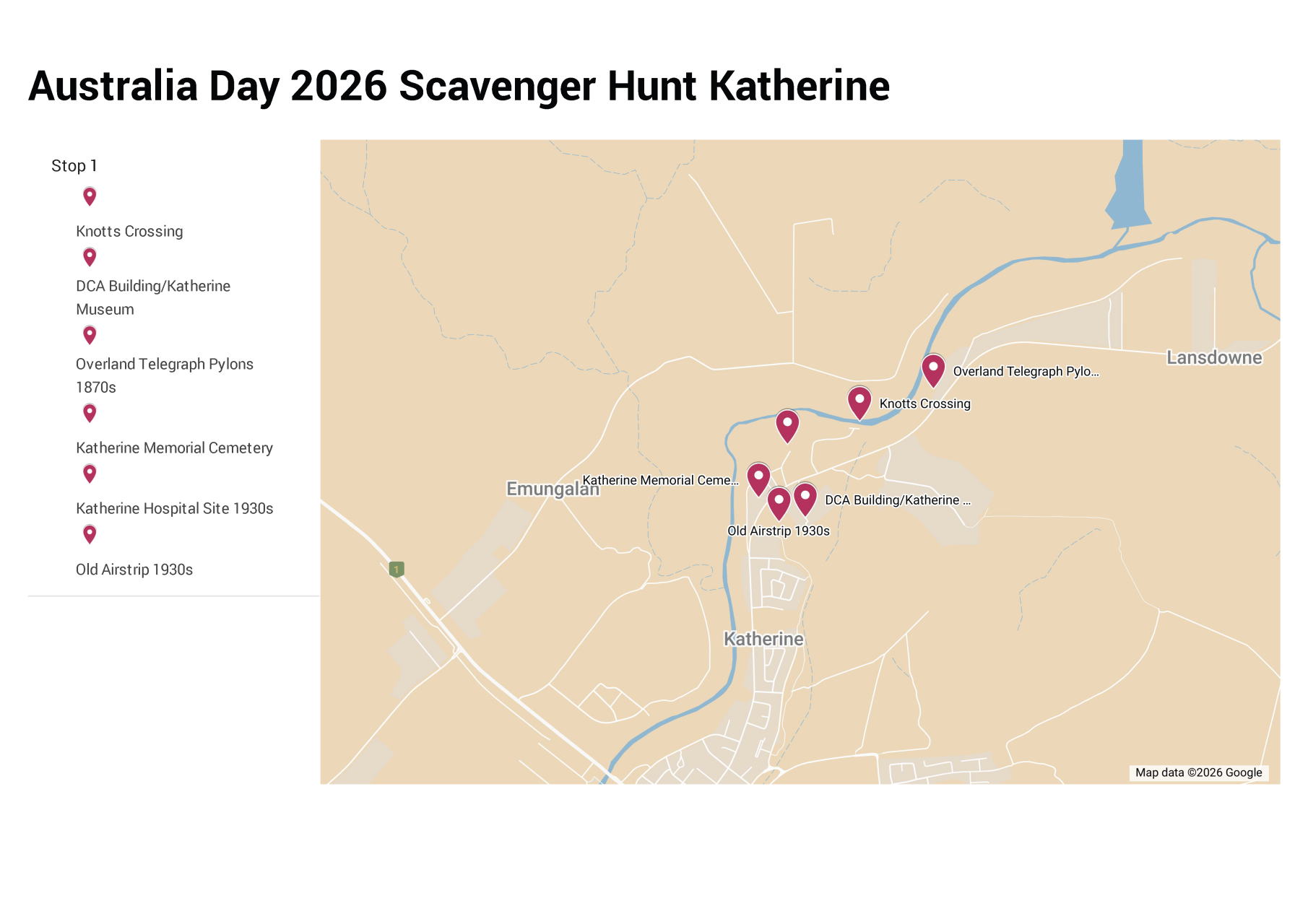
Explore the first settlement of Katherine - Knotts Crossing, Overland Telegraph
The crossing below here is known to the Jawoyn people as Mundubbrah and is associated with the travels of the left-handed kangaroo.
In 1870, the original settlement of Katherine at Telegraph Reserve was founded by Charles Todd. It was little more than a shantytown in the early 1870’s, which included a telegraph station, a general store, and a hotel.
Todd was appointed Postmaster General, in charge of the construction of the Overland Telegraph Line. It was the heart of early Katherine and home to its first bush pub. The Katherine Telegraph Station opened in 1872 near the crossing. This telegraph line connected Australia from north to south.
Knotts Crossing has undergone several name changes, including McKeddies Crossing and Nixon’s Crossing. Today it is known as Knotts Crossing – after Kate and Fred Knott, who took over the hotel and store in 1929.
Knotts Crossing was the first crossing that was a part of the ‘Track’ from south to north and the main road to Darwin. It was a rough crossing, and it was cut off for many months during the wet season. The river could flood up to 20 metres and the volume of water isolated the early settlement of Katherine. The early Knotts Crossing was used by many pioneers, including the first woman explorer, Emily Caroline Creaghe, Jeannie Gunn, Alfred Giles, and Tom Pearce – Mine Host.
Fun facts!
Knott’s Crossing is still walkable today, but only when the river is within its dry season banks. It is a historic river pass and movie set for Rogue.
Booze by the Gallon: In the rough-and-tumble 1870s, Katherine’s first liquor store, located near Knotts Crossing, operated under a peculiar law – a “gallon license.” This meant you couldn’t buy just one beer; you had to buy at least a gallon of alcohol at a time! The old Gallon License Store (built near the river crossing) served thirsty telegraph workers and pastoralists, essentially the 19th-century version of a bulk-buy deal. (No wonder early visitors never went thirsty.)
QUIZ:
Flooding at Knotts Crossing would isolate the township’s early residents. How high has the river risen in the past?
Cyclone Les in 1998 brought over 400 mm of rain in 48 hours, overwhelming Katherine and causing the town's worst flood in recent history. On Australia Day, 28 years ago, the river rose to 21.3 metres, submerging the town. The date is now etched in local memory for both a moment of progress and a moment of chaos. Katherine was declared a National Disaster Area with three lives lost and 1,100 homes damaged.
How high is the river today?
Enter your answers
OPTIONAL: Explore other parts of the Telegraph Crossing:
The Katherine airstrip, located across the road from Katherine Town Cemetery, opened in 1919, making it one of the NT’s earliest aviation sites.
Aboriginal warrior and WWI hero Corporal Frederick Prentice was buried in an unmarked Katherine grave until 2021. Local elders fought for 7 years to get Prentice’s grave marked, honouring his legacy.
The old hospital treated soldiers and civilians, and locals say its halls are still haunted. A crocodile once blocked the entrance to the Katherine Hospital—true Top End drama!
*information from Simmone Croft and Katherine Town Council heritage signs and archives.